 |
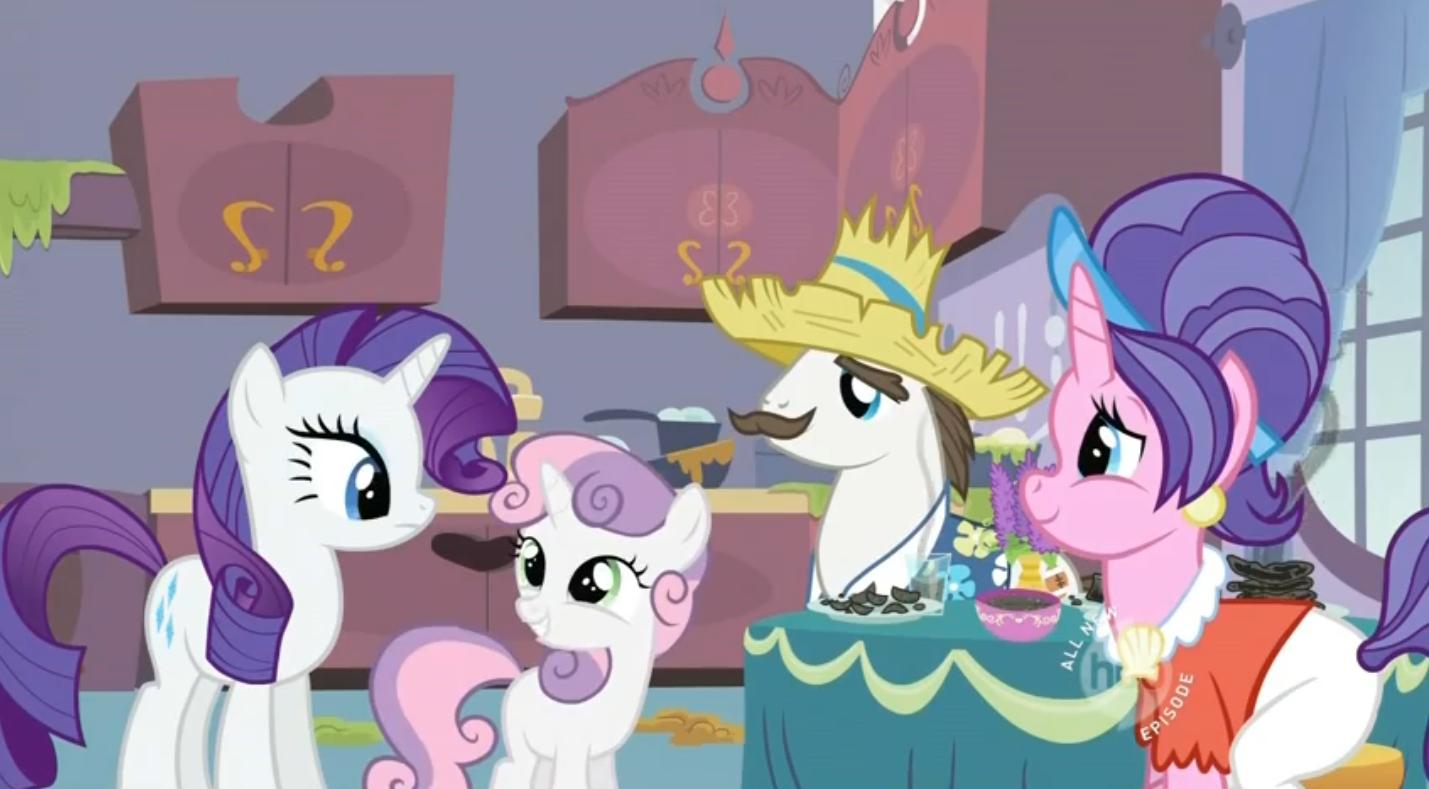
Normally I would make a silly comment, but I'm too
distracted by Rarity's mother's pants. Have we EVER seen
a pony wearing pants before this? Do we ever again? |
It's November 5, 2011, and so, for no reason other than that it pleases me to do so, I offer you this bit of
doggerel with apologies to Alan Moore and centuries of folk tradition:
Remember, remember
The Fifth of November
The two sisters who were not
I know of no reason
This sisterhood season
Should ever be forgot
The top song is still the exact same tiresome bit of Adele, and the top movie this weekend is
Puss in Boots,
the horrifyingly awful spinoff of the horrifyingly awful, omnipresent, and never-ending
Shrek series. Rather appropriately, the series took a weekend off between the last episode and this one, which I completely should have cited when I decided to do a guest post. Ah, well. In the two weeks since last episode, an earthquake in Turkey killed hundreds of people, but did not stop the world's population from hitting seven billion on Halloween. In a not unrelated story, the U.S. Department of Energy reveals that 2010 greenhouse gas levels were worse than the worst-case scenarios published by the ICCC four years prior. And twice in these two weeks, Oakland, California police respond violently to that city's Occupy protests.
"Sisterhooves Social" is one of Cindy Morrow's more interesting episodes for me, but curiously, the first time I watched it I found it entirely forgettable. I'm not sure I've rewatched it since, which makes it one of the episodes I've watched least (though there is one episode, which shall remain unnamed, which I have only ever seen once). I'm not sure how I missed this the first time, possibly because it's been on my mind lately, but in large part this is a study of the gap between the intention behind an action and how that action is perceived by others.
There's a term for this phenomenon in third-wave feminist circles: Intent Isn't Magic. (Sometimes with an f-bomb thrown in there, but this is a scholarly, serious site about a children's show, and that kind of language just isn't fucking acceptable.) Though it's usually applied to discussions of gender relations, it applies just as well to Sweetie Belle and Rarity's interactions in this episode. Throughout the first part of the episode, Sweetie Belle has the best of intentions to help her sister, but her actions at first inconvenience Rarity, then destroy her property, and finally seriously set back her work. Rarity, meanwhile, eventually approaches Sweetie Belle with the intent of making peace, but her actions--suggesting activities only she likes, for instance--only drive the two further apart.
I'm actually going to take this a step farther than it's usually taken, and stake out a fairly extreme position: intent isn't just not magic, it's irrelevant. Of course, having said it I'm going to pull back slightly: my intent is relevant to me, but not to you. Your intent is relevant to you, but not to me.
The problem with the intent of others is that it's utterly unknowable. All that can be known is another's actions. Even if you tell me your intentions, I can't rely on that, because you could be lying or mistaken (how often have you done something with what you thought were good intentions, and realized after the fact you had ulterior motives or were just rationalizing?) Of course, fictional characters are different. Fiction has a very low information density compared to reality, which means we can interpolate and interpret much more freely and confidently because all the information that
is there can be assumed to be relevant. In other words, because even the most complex fictional character is always going to be vastly simpler and more straightforward than any real human being, we can read their intentions reliably. Thus, the audience knows Sweetie Belle is trying to help and shares her frustration at the repeated failure of her efforts. However, to Rarity, Sweetie Belle is real, and thus her intentions are not readable. Rarity isn't a mind-reader, so she has no choice but to respond to Sweetie Belle's (repeatedly destructive) actions.
Both Rarity and Sweetie Belle find, by the end of the episode, that their intentions cannot enable them to get along; only by
changing their behavior can they maintain the bond between them.
I want that written in letters of fire ten thousand feet high. I want that burned into the insides of the eyelids of every human being who ever lived or will live. I want that to be the national anthem of every country and the fight song of every school.
What you were trying to do
only matters to you. What you meant to do, what you intended to happen,
only matters to you. To the
entire rest of the universe, what matters is what you
actually do and how it impacts others.
And if that impact is not what you intended for it to be? Then you are doing it
wrong and you need to do it
differently. If your intentions really are what you think they are, that won't even be difficult; you'll just naturally keep trying things until you get the results you're trying for. Because we know both their intentions, thanks to their fictionality, we know Rarity and Sweetie Belle will eventually work it out, barring some swerve that comes from some story element outside their characters (which is fairly unlikely in anything not by Joss Whedon or George R. R. Martin). They both genuinely
want to get along, and therefore they eventually will find a way to do so. Which is another way of saying intent might not be magic, but friendship is.
This really is the next stage after Lesson Zero, and well-placed here, just a couple of episodes after. After recognizing the internality of others, that you cannot ever truly understand what happens inside another person but must accept it, the next step is to realize that they will never truly understand what happens inside your head, that you are more opaque than you realize, and that you will sometimes have to adjust your words and actions because others don't see the thoughts and feelings behind them.
Which brings us to an odd question: Did Morrow intend for this episode to be an examination of the Intent Isn't Magic concept? On one level, we can say probably not: the explicit friendship lesson is about compromise. On the other hand, well, does it matter what she intended? The episode works as an examination of the Intent Isn't Magic concept, and therefore it is one. It follows naturally from the friendship lessons on communication and not making assumptions that predominated shortly before Pinkie Pie broke the show at the end of the first season, and ties them together with the Spike/Nice Guy Syndrome theme. (Spike being a classic example of someone who claims his intention is the benefit of another, but whose actions--and, more importantly, his repeated failure to modify his behavior when it fails to produce the results he supposedly intends--make it clear he's not really after that at all.)
Like everything else that speaks directly to bronies, it might not be intentional, but nonetheless ends up being there. And like I've been saying all along, what the creators of the show
do matters more than what they say they intended. Was Rarity's conflict with Sweetie Belle intended to be more of a "don't touch my stuff" thing than the more cleanliness-based conflict it ended up being, as Faust suggested in her recent Q&A on 4chan? Doesn't matter--what matters is the episode that actually aired.
This isn't, I should note, the Death of the Author. There's no rule
against considering authorial statements of intent. I've implied (in, admittedly, a moderately gonzo post) that "The Return of Harmony" can be read as a Gnostic fable; do you really think I'd object to an attempt to read it as the product of the stated intentions of the people who made it?
Instead, what I'm arguing is that Authorial Intent Isn't Magic. The work is what it is and has the impact it has, and if it doesn't have the impact the author intended it to have, then it is up to the author to adjust their future work. Saying "Oh, I actually meant
X" when people experiencing the work come away with
Y is as empty as Sweetie Belle saying she was just trying to help. This isn't to erase the creator--far from it! I have a deep and abiding respect for anyone with the skills to create any kind of art. (Especially the visual arts. I can write, not just in the sense of stringing words into sentences but in the sense of being able to create fiction. I understand how writing works, so even when someone is a much better writer than me, I can sort of see how they did it. Drawing, on the other hand, is basically witchcraft as far as I'm concerned--you put lines on paper and
suddenly there is an image. How that's even
possible is beyond my feeble brain.)
Instead, what I'm trying to do is prevent creators from overshadowing their work. Case in point, not that long ago on this very blog, a commenter objected to one of my Pony Thoughts of the Day with the words "
Faust already said Scootaloo is flightless." Not to pick on them, because this is endemic in fandoms in general, but this was well after at least two episodes of Season Three showed Scootaloo flying.
Ultimately, for all that it may be a harsh lesson, in the context of "Sisterhooves Social" the message that Intent Isn't Magic is a welcoming one, because we were never intended. The show was never made with bronies in mind, and yet here we are.
Because whether they intended to or not, the folks at DHX made a show that is, blatantly obviously in just about every frame, for us. That doesn't mean it's just for us, or that we don't have to share--but it is for us, and that's pretty nice to have.
Next week: It's Amy Keating Rogers. Writing an Apple-centric episode. Yay.

